ICLR 2026
VQ-Transplant
Efficient VQ-Module Integration
for Pre-trained Visual Tokenizers
1University of Toronto 2Boston College 3Vijil
Can we develop new VQ methods without retrainingan entire visual tokenizer?
In our paper, we show that a new quantizer can be transplanted into a frozen, pretrained tokenizer, then aligned with just five epochs of decoder adaptation on ImageNet-1K.
01 / Motivation
Change the quantizer.
Keep the tokenizer.
Modern visual tokenizers couple the encoder, quantizer, and decoder in one expensive training loop. Testing a new VQ method therefore means repeating adversarial training at scale.
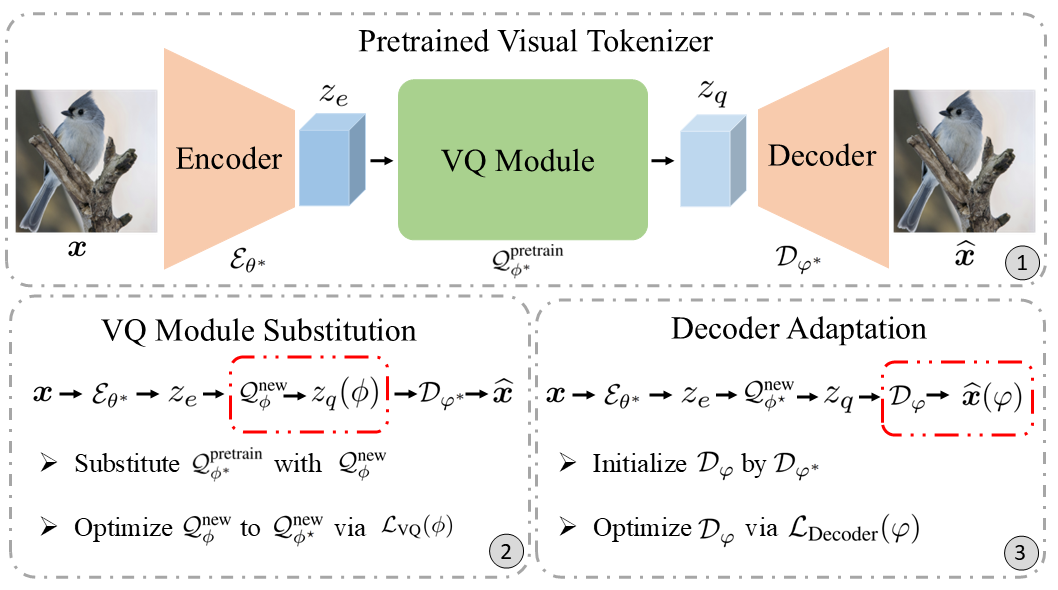
VQ-Transplant separates quantization research from tokenizer training. It reuses the encoder and decoder of a strong pretrained model, replaces only the native VQ module, and repairs the resulting decoder mismatch with a short adaptation phase.
From scratchEncoder + VQ + DecoderOpenImages · 16 A100s · 60 hours for VAR
VQ-TransplantNew VQ + adapted DecoderImageNet-1K · 2 A100s · 22 hours
02 / Method
A two-stage transplant
The framework preserves the pretrained representation, learns a compatible codebook, and adapts only the component that must read the new latent space.
VQ module substitution
Encode images with the frozen encoder and train the new quantizer to minimize quantization error plus its method-specific uniqueness objective.
Decoder adaptation
Freeze the encoder and new quantizer. Update the pretrained decoder with reconstruction, perceptual, and adversarial losses for five epochs.
03 / MMD-VQ
Match distributions,
not just moments.
MMD-VQ aligns encoder features and codebook vectors with Maximum Mean Discrepancy. A characteristic multi-Gaussian kernel matches the full distributions without assuming Gaussian features.
D2MMD(X, Y) = E[k(x,x′)] + E[k(y,y′)] − 2E[k(x,y)]
Wasserstein-VQ uses a Gaussian closed form that aligns first and second moments. MMD-VQ remains expressive for multimodal, heavy-tailed, and other non-Gaussian latent distributions, while retaining high codebook utilization.
04 / Results
Less training, stronger reconstruction
MMD-VAR with 8,192 codes improves on the pretrained VAR tokenizer after five adaptation epochs, using 22 total training hours.
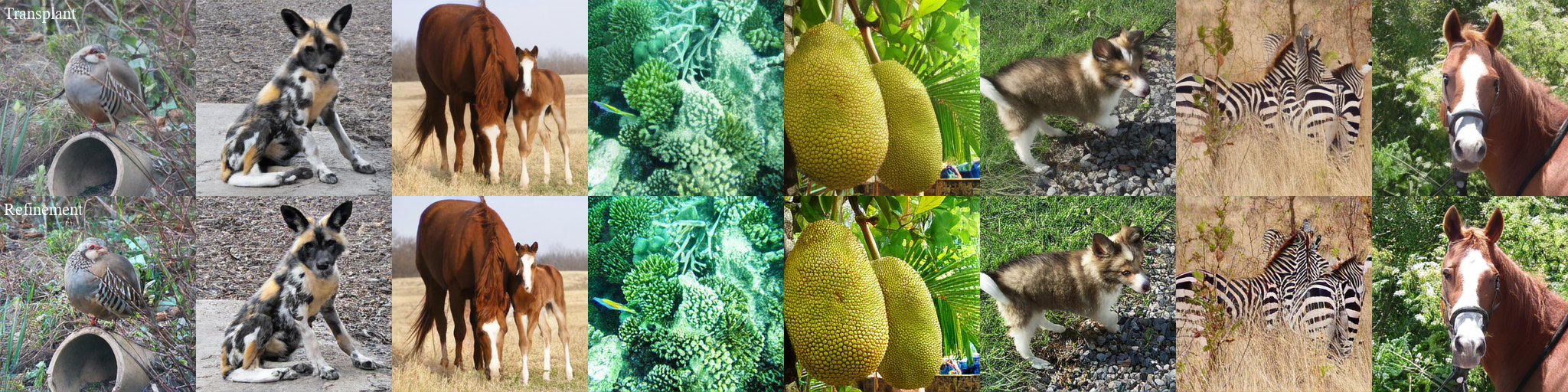
Decoder refinement
Adaptation restores high-frequency detail.
VQ substitution reduces quantization error, but the frozen decoder still expects its original latent distribution. A short adaptation phase resolves this mismatch and sharpens the reconstruction.
05 / Generalization
One framework, three domains
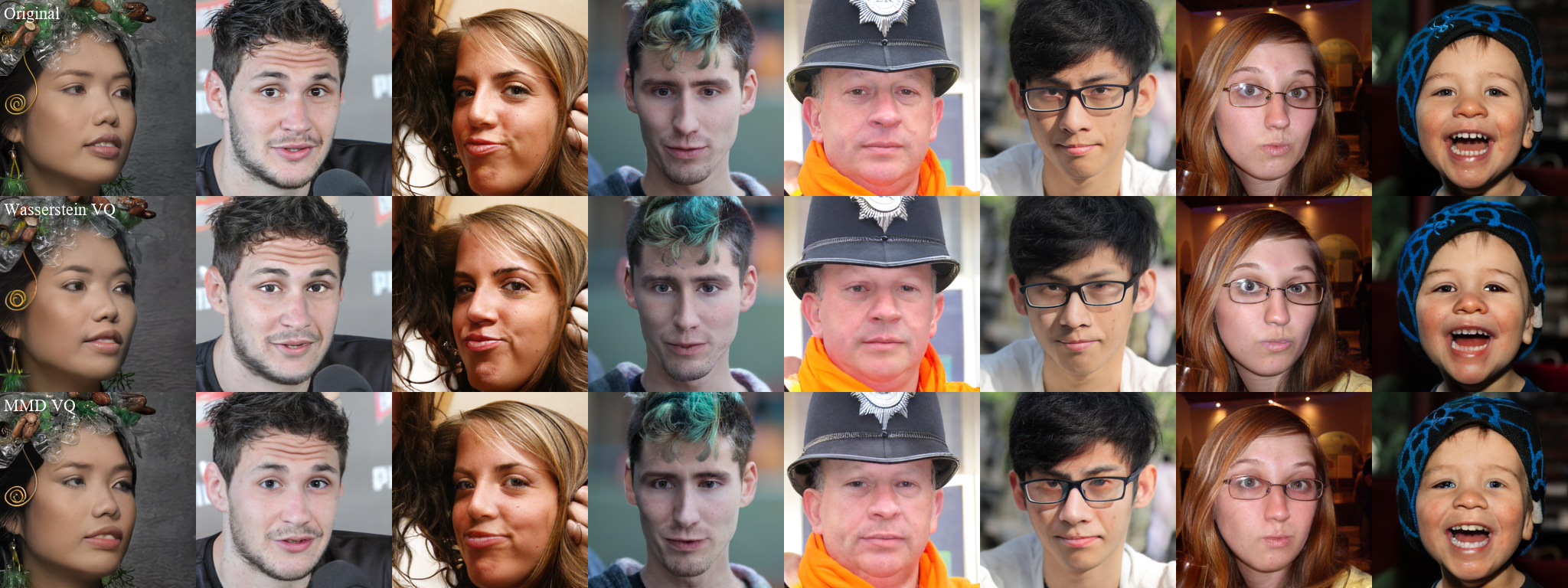
Fixed-scale Wasserstein-VQ and MMD-VQ transplant cleanly across faces and churches, datasets structurally distinct from the tokenizer's OpenImages pretraining data.
FFHQ256 × 256
CelebA-HQ256 × 256
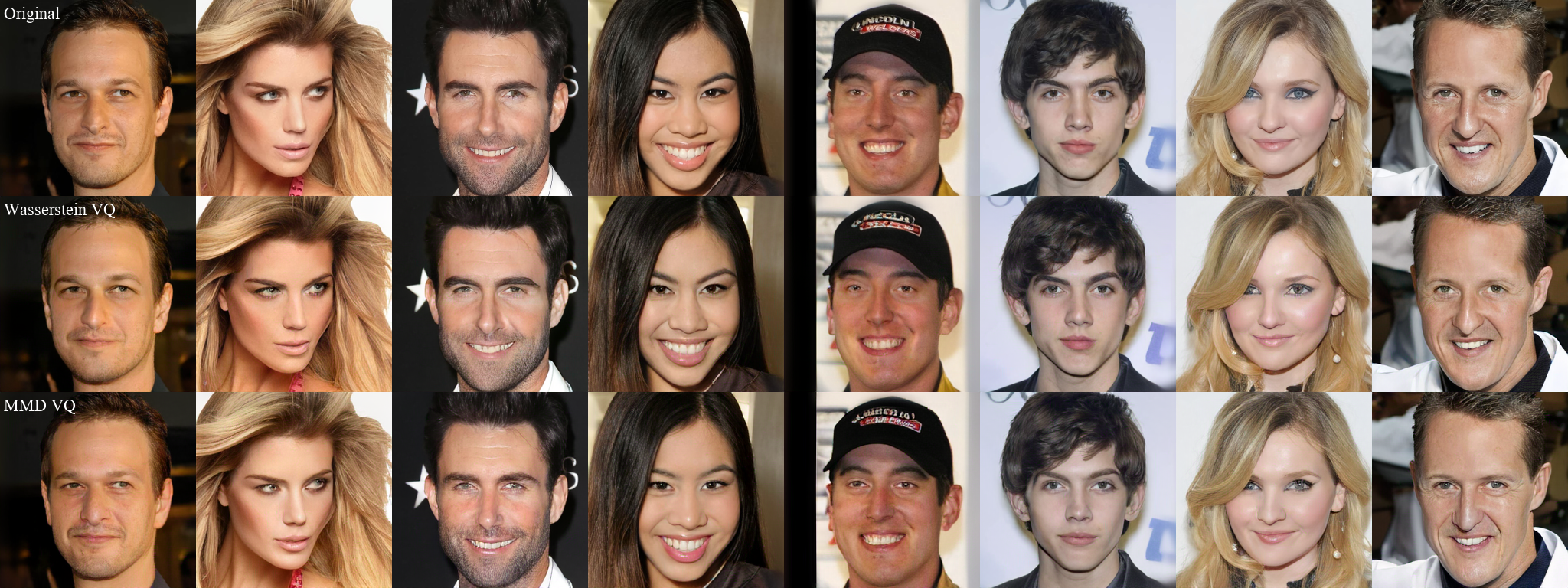
LSUN-Churches256 × 256
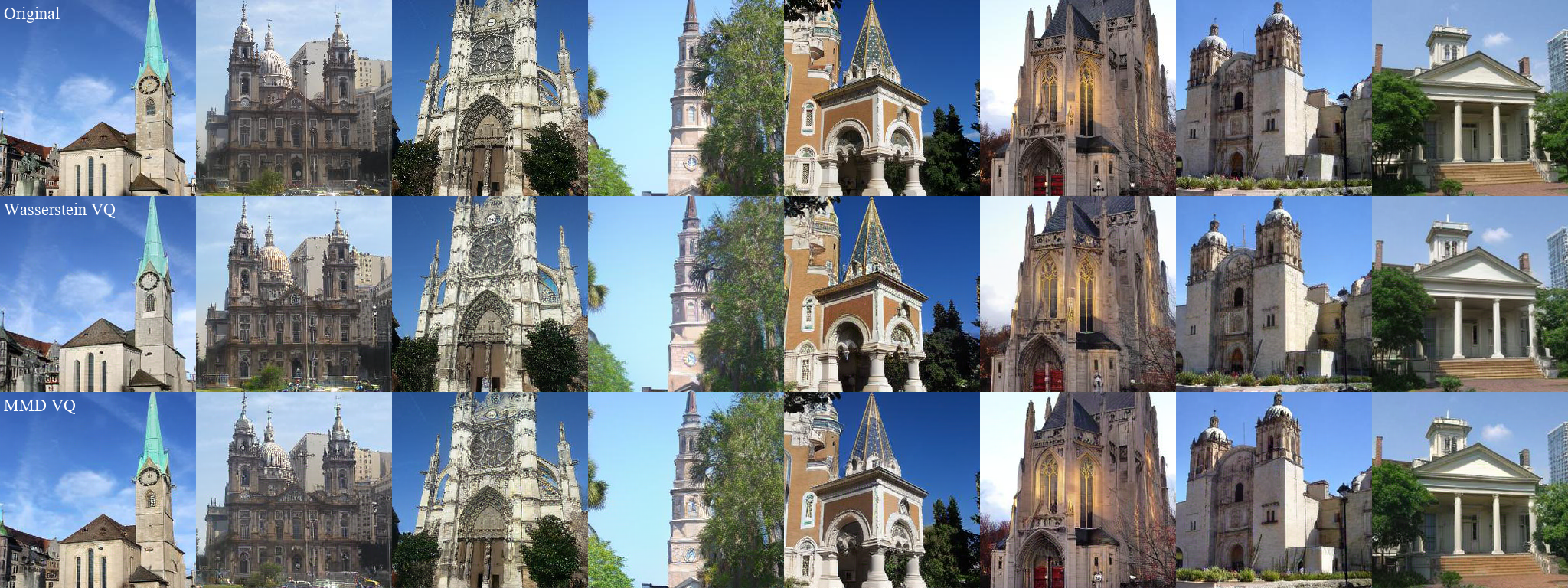
Across all three datasets, distribution-aligned quantizers achieve near-complete codebook utilization and preserve fine identity, texture, and structure after transplantation.
06 / Takeaways
- VQ-Transplant replaces a quantizer without repeating full tokenizer training.
- Five epochs of decoder adaptation align pretrained decoder priors with the new latent space.
- MMD-VQ matches non-Gaussian feature and codebook distributions without parametric assumptions.
- MMD-VAR reaches 0.81 rFID with 100% codebook utilization at 21.8× faster training than VAR.
07 / Citation
Build on our work
View code ↗@inproceedings{fang2026vqtransplant,
title = {VQ-Transplant: Efficient VQ-Module Integration for Pre-trained Visual Tokenizers},
author = {Fang, Xianghong and Yuan, Yuan and Kong, Dehan and Rudner, Tim G. J.},
booktitle = {International Conference on Learning Representations},
year = {2026}
}